From operating scenario to RFQ
Bulk Cargo Semi Trailer Manufacturers for Defined Cargo Duties
Different bulk movements can share a trailer label while requiring different bodies, discharge systems, running gear, cleaning provisions, and logistics plans. We help business buyers express the operating case before asking manufacturers to quote.
Map Your Cargo Duty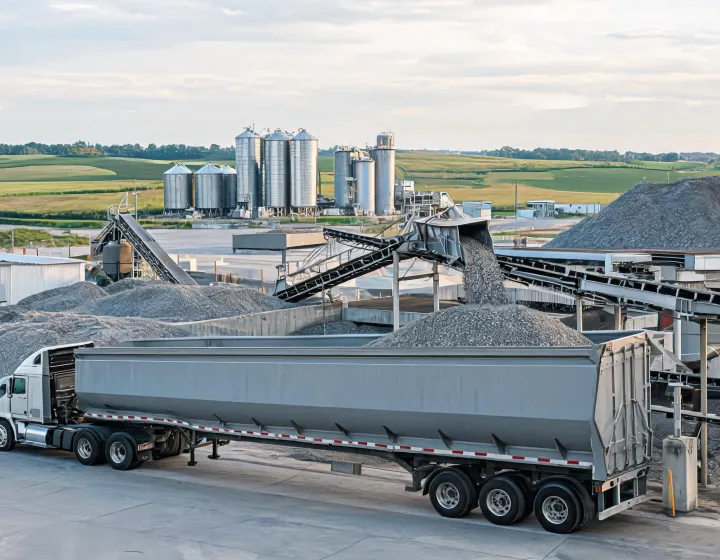
Application translation
Define the operating case in four layers
Cargo behavior
Give material name, bulk density, particle size, moisture, contamination sensitivity, flow behavior, temperature, and any lining or cleaning expectation. Volume alone does not establish viable payload.
Terminal interface
Describe loading equipment, outlet height, tipping or pneumatic discharge, available air or power, queue cycle, clearance, turning area, ground condition, and unloading target.
Route and ratings
State route type, distance, grade, speed, tractor and coupling assumptions, applicable gross and axle limits, payload objective, axle group, suspension, tires, brakes, and stability needs.
Delivery and evidence
Record units, destination, Incoterm, inspection points, packing, spare scope, drawings, rating documents, material statements, model year, and requested delivery window.
Procurement scenarios
Match the trailer body and evidence request to the duty
Grain, feed, and agricultural inputs
Flowability, moisture exposure, food or feed contact expectations, cleaning access, contamination control, seasonal throughput, and unloading interface shape the body and discharge brief.
Ask how rated volume relates to the stated bulk density and payload target. Confirm liner or surface material, outlet arrangement, sealing, inspection access, tare assumption, and the exact axle and brake configuration.
Aggregates and dense mineral cargo
High density can reach legal or component load limits before filling the body. Abrasion, impact, site grade, tipping clearance, ground stability, and cycle frequency require explicit review.
Compare material thickness and grade without treating thicker as automatically better; mass reduces payload. Confirm body geometry, wear protection, frame and hoist basis, axle distribution, tire ratings, stability assumptions, and discharge-site constraints.
Cement, powder, and pneumatic discharge
Powder behavior, aeration, pressure-system scope, contamination, moisture control, discharge rate, receiving silo connection, compressor arrangement, and cleaning method affect the complete system.
Define vessel or body basis, compartmenting, valves, piping, air source, pressure-related documents, hose and coupling interface, tare, axle layout, and which components are included. Do not infer approval from a generic factory document.
Multi-cargo dealer or fleet programs
A single order can include different cargo densities, routes, outlets, and destination rules. Standardization may simplify service and spares, while over-standardization can create payload or unloading compromises.
Separate each configuration and quantity, then compare common components, spare strategy, drawings, markings, inspection, warranty, training, packing, and staged delivery. Alternatives need a deviation list rather than a generic equivalent label.
Trade-offs
Application choices that need evidence, not slogans
The right choice depends on cargo, legal and component ratings, route, unloading method, maintenance capability, and total procurement scope.
More volume or more payload?
A larger body supports low-density cargo but adds tare and can create axle-distribution or clearance issues. Compare rated volume and exact tare against cargo density, legal limits, axle ratings, and route constraints.
Lighter construction or heavier wear protection?
Weight reduction can preserve payload; heavier materials or liners may suit abrasive duty. The decision needs material grade, thickness, fabrication detail, expected cargo, duty cycle, repair approach, and mass effect.
Factory price or landed procurement cost?
A factory-gate figure can exclude options, inspection, documents, inland transport, export handling, freight, duty, insurance, and destination services. Normalize every response to one Incoterm and destination.
Standard configuration or tailored discharge system?
Standardization can simplify spares and service, while site-specific outlets or pneumatic equipment may reduce handling constraints. Confirm interfaces, utilities, cycle target, maintenance access, and included components before choosing.
Turn the cargo route into a manufacturer-ready request
Share cargo properties, terminal interfaces, route, ratings, body and discharge preferences, quantity, destination, inspection, documents, and timing. Candidate offers can then be compared without hiding application differences.